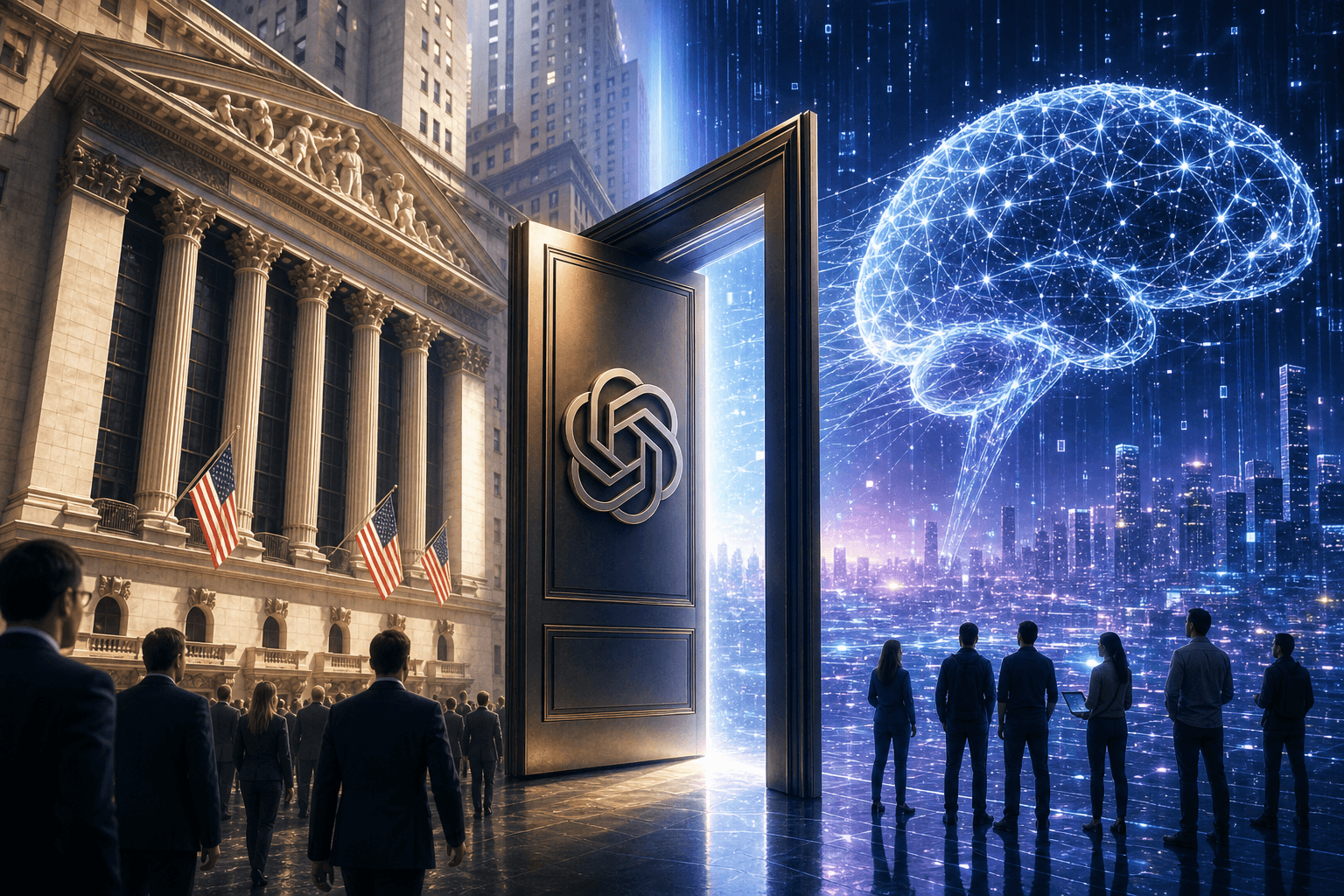

Builders tracking AI infrastructure need to read the OpenAI IPO S-1 filing carefully. OpenAI projects a $14 billion net loss in 2026 on $25 billion in annualized revenue. It spends $1.22 for every dollar earned. The IPO is a capital raise, not a proof of stability.
That number does not exist in isolation. It landed in the same week that Microsoft formally converted its exclusive OpenAI model license to non-exclusive, that Visa announced it is embedding its payment rails directly into ChatGPT, and that Anthropic split its most capable model into two distinct access tiers. Most coverage treats these as four separate stories. They are not. They are four moves in the same contest over who controls AI infrastructure at scale.
The Microsoft deal determines distribution: which cloud providers can now ship OpenAI models and on what terms. The Visa deal determines the commerce layer: who owns the transaction relationship when an AI agent buys something. The Anthropic release determines the safety access layer: who decides which users get the most capable cyber-relevant AI. The S-1 determines capital formation: who funds the race.
Operators who track these as separate news items will miss the structural shift underneath them. This post covers all four together and draws out the practical implications for builders and businesses who depend on AI infrastructure.
What Does OpenAI's S-1 Filing Actually Reveal?
On June 8, 2026, OpenAI confirmed a confidential draft S-1 submission to the SEC, targeting a Q4 2026 public listing. The valuation target sits between $852 billion and $1 trillion, with Goldman Sachs and Morgan Stanley as lead underwriters. According to financial analysis of the filing, OpenAI discloses 50 million consumer subscribers and 9 million business users. That is the first verified count of the platform's installed base, not a third-party estimate.
The OpenAI IPO S-1 filing also shows the company spent $1.22 for every $1.00 earned in Q1 2026. Projected net losses for 2026 land at $14 billion non-GAAP and potentially $25 billion or more GAAP when share-based compensation is included. These are not rounding errors. They are structural realities of what it costs to run frontier AI at consumer scale.
For builders treating OpenAI as long-term infrastructure, these numbers are the starting point for every pricing and vendor decision. Claude has overtaken ChatGPT in business adoption for the first time, which gives this filing a competitive backdrop that sharpens its stakes considerably.
Why Is OpenAI Burning Cash at This Scale?
Inference compute is the dominant cost driver. Running frontier models for 50 million subscribers requires continuous GPU spend that does not compress the way software margins do. Revenue can double and costs follow close behind. That is not a software business. That is closer to running a global power utility.
Research investment to maintain frontier status is an ongoing operating cost, not a one-time build. If OpenAI slows spending, it cedes capability ground to Anthropic, Google DeepMind, and others in a matter of months. The race structure makes meaningful cost reduction difficult without also surrendering the lead.
HSBC estimates a $207 billion funding gap through 2030. That figure means the IPO is a financing vehicle, not a finish line. OpenAI will need to raise more capital well after listing. Public investors are funding a race, not buying a stable mature business. If you are tracking what AI tasks cost per unit today, build in pricing tightening once quarterly earnings pressure begins post-listing.
How Does the Microsoft Restructure Change AI Distribution?
On April 27, 2026, Microsoft and OpenAI converted their partnership from an exclusive license to a non-exclusive one through 2032. That single change allows OpenAI to serve its products across any cloud provider for the first time in the partnership's history. Azure retains a conditional first-mover window: new frontier model releases ship on Azure first, unless Microsoft cannot or chooses not to support the necessary capabilities.
Revenue sharing also changed direction. Microsoft no longer pays OpenAI a share of AI revenue. OpenAI continues paying Microsoft through 2030 under a capped structure. Read that directionally: OpenAI's dependency on Microsoft's balance sheet is declining. The company traded some exclusivity for the right to build a broader commercial footprint before its IPO.
For enterprise buyers, this opens real room to negotiate multi-cloud AI contracts that were not available before April 27. The standard argument for routing all AI workloads to Azure has weakened. Evaluate whether AWS Bedrock or Google Vertex now offer viable paths to OpenAI models at better commercial terms for your stack.
What Does Visa Inside ChatGPT Mean for Agentic Commerce?
On June 11, 2026, Visa confirmed it is embedding its payment network directly into ChatGPT, with the integration set to enable AI agents to authorize and complete purchases on behalf of users. The framework uses tokenized Visa credentials with real-time authorization and fraud monitoring. Users set configurable spending caps, merchant category restrictions, and approval requirements. The agent operates inside a permission envelope, not with unconstrained purchasing authority.
This is infrastructure capture, not a product feature. The party that owns the payment rail inside an AI interface owns the transaction relationship at scale. Visa is moving ahead of every competing payment network and every AI-native checkout startup by embedding before the interface becomes habit.
For operators running any commerce, booking, or subscription flow, this is the most consequential deal of the week. If your product sits in a purchase decision path, map what agentic payment authorization means for your conversion funnel before a competitor does. The window to set a first-mover position in agentic commerce defaults is open right now and will not stay open long.
Why Did Anthropic Ship Two Models in the Same Week?
On June 9, 2026, Anthropic released two models in a single announcement. Claude Fable 5 reached general availability with full capability across software engineering, knowledge work, vision, and scientific research. Standard safeguards block high-risk cybersecurity and biology responses for all open-market users.
Claude Mythos 5, built on the same underlying architecture, had those cyber safeguards selectively removed. It was released only to a restricted group of vetted cyber defenders and critical infrastructure providers through a program called Project Glasswing.
The split is deliberate. Anthropic is not withholding capability from the market. It is controlling access to the most sensitive slice of that capability. Fable 5 goes to everyone. Mythos 5 goes only to vetted defenders. That structure lets Anthropic ship its most powerful model without placing offensive cyber tools on the open internet.
This is the safety layer of AI infrastructure being privately claimed, without waiting for regulatory frameworks to catch up. The same gatekeeping posture will shape how Anthropic's own IPO filing targets its valuation when public investors assess the safety-capability tradeoff directly.
Who Actually Controls AI Infrastructure After This Week?
After the Microsoft restructure, frontier AI distribution is no longer controlled by one cloud. AWS and Google Cloud now have legitimate pathways to OpenAI's most capable models. That changes the calculus for every enterprise team that locked into Azure primarily for AI access. The exclusivity argument for Azure AI workloads is materially weaker as of April 27.
Visa moving into ChatGPT means the commerce layer of AI is being claimed by incumbent financial infrastructure, not built natively inside the AI platform. That is a bet that existing trust networks, tokenization rails, and compliance frameworks matter more at the point of purchase than anything an AI-native payment startup can replicate quickly.
Anthropic's tiered release signals that the safety layer is also being privately contested. No government body set the cyber access rules here. Anthropic did. Distribution, commerce, and safety access: three infrastructure layers claimed in one week. The state of LLMs in June 2026 shows this is not an isolated burst. It is how AI power is consolidating right now, one infrastructure layer at a time.
What Should Builders and Businesses Do With This Information?
The OpenAI IPO S-1 filing introduces quarterly earnings pressure that private operation never created. Pricing adjustments, faster model deprecation cycles, and new access tiers are all more likely post-listing. Plan for at least one pricing structure change in the 12 months after the public debut. Baseline your cost per successful AI task today before the terms shift.
The Microsoft non-exclusivity opening creates real room to renegotiate multi-cloud AI contracts. Evaluate whether AWS Bedrock or Google Vertex now offer OpenAI-native capability at better commercial terms. The window to move is now, while the change is fresh and before enterprise defaults reset around the new structure.
Agentic payment flows are live announced infrastructure in 2026, not a proof of concept. If your product involves any purchase decision or booking flow, map your checkout conversion against what Visa-in-ChatGPT enables before a competitor does. Builders who move first on agentic commerce positioning will set the defaults everyone else has to match.
Run a business? AI Mastermind is our coaching program for owners putting AI to work. The builders already inside are working through exactly these vendor, pricing, and platform decisions in real time. Share what you are rethinking and pick up what others are already building.
FAQ
What does OpenAI's S-1 filing mean and when will the IPO happen?
OpenAI confirmed on June 8, 2026 that it had confidentially submitted a draft S-1 registration statement to the U.S. Securities and Exchange Commission. A confidential filing allows a company to start the regulatory review process without making its full financials public immediately. OpenAI is targeting a Q4 2026 public listing at a valuation between $852 billion and $1 trillion. Goldman Sachs and Morgan Stanley are the lead underwriters. The exact listing date has not been confirmed and OpenAI has signaled timing could shift. The S-1 is not the IPO itself. It is the document that makes a public offering legally possible once the SEC completes its review and OpenAI chooses to proceed with a road show.
Is OpenAI making money before its IPO?
OpenAI is generating significant revenue but is not profitable. By March 2026, the company had reached a $25 billion annualized revenue run rate, with 50 million consumer subscribers and 9 million business users. However, it is spending $1.22 for every $1.00 it earns, with projected net losses of $14 billion in 2026 on a non-GAAP basis and potentially $25 billion or more on a GAAP basis when share-based compensation is included. Inference compute costs alone are projected at $14 billion in 2026. HSBC estimates a $207 billion funding gap through 2030, meaning OpenAI will need to raise additional capital well beyond the IPO proceeds to sustain current operations at scale.
What changed between Microsoft and OpenAI in 2026?
On April 27, 2026, Microsoft and OpenAI restructured their partnership agreement. The most significant change is that Microsoft's license to OpenAI's intellectual property and models converted from exclusive to non-exclusive through 2032. This means OpenAI can now distribute its models on AWS, Google Cloud, and other cloud providers rather than exclusively through Azure. Microsoft retains a first-mover window, so new OpenAI frontier models still debut on Azure before appearing on competing clouds. The revenue sharing structure also changed: Microsoft no longer pays OpenAI a revenue share, while OpenAI continues paying Microsoft through 2030 under a capped structure. Microsoft remains a major OpenAI shareholder and its license to OpenAI's IP continues through 2032.
What does Visa integrating with ChatGPT actually do for users and businesses?
Announced June 11, 2026, the Visa and OpenAI partnership embeds Visa's payment authorization infrastructure directly into ChatGPT. AI agents can complete purchases on a user's behalf using linked Visa card credentials without requiring manual checkout each time. Users retain control through configurable spending caps, merchant restrictions, and approval requirements set in advance. Visa supplies the tokenization, fraud monitoring, and network authorization behind each transaction. For businesses with digital storefronts, this means AI-initiated purchase flows become a real transaction channel rather than a concept. The practical implication is that checkout systems need to support agent-originated transactions, not just human-initiated ones, and Visa is now the network providing that credentialing layer inside ChatGPT.
What is Claude Fable 5 and how is it different from Claude Mythos 5?
Anthropic released both models on June 9, 2026, but with different access policies. Claude Fable 5 is the broadly available version, described as state-of-the-art across software engineering, knowledge work, vision, and scientific research. It includes safeguards that block responses in high-risk areas, particularly cybersecurity and biology. Claude Mythos 5 is the same underlying model but with those cyber safeguards removed. Access to Mythos 5 is restricted to a small group of vetted cyber defenders and critical infrastructure providers through a program Anthropic calls Project Glasswing. The split lets Anthropic make its most capable model available for legitimate defensive security work without releasing offensive cyber capabilities to the general market.
How does OpenAI going public affect developers and businesses using the API?
A public listing changes OpenAI's incentive structure in ways that matter for anyone building on its API. As a private company, OpenAI could absorb losses and prioritize growth over margin. As a public company, it will face quarterly earnings pressure from institutional shareholders who expect a path to profitability. In practical terms, this could accelerate pricing adjustments to API tiers, faster deprecation cycles for older models, or changes to enterprise terms that are not present under private operation. The Microsoft restructure opening up AWS and Google Cloud as distribution channels also gives developers more negotiating leverage in 2026, because OpenAI now competes for enterprise relationships across multiple platforms rather than defaulting every buyer to Azure.
What is agentic commerce and why does the Visa-ChatGPT deal matter now?
Agentic commerce means AI systems completing purchases autonomously on behalf of users, rather than users manually going through a checkout flow. Examples include an AI agent booking a flight, ordering supplies, or renewing a subscription within a permission boundary the user defines in advance. The Visa-ChatGPT deal matters because it is the first major deployment of this model with real payment infrastructure from an established global network. OpenAI's own prior attempt, an Instant Checkout feature, was discontinued in March 2026 after failing to scale beyond a small number of merchants. Visa brings tokenization, fraud monitoring, and issuer relationships that a checkout startup or AI-native payment layer would take years to replicate. Agentic commerce is moving from concept to infrastructure in 2026.