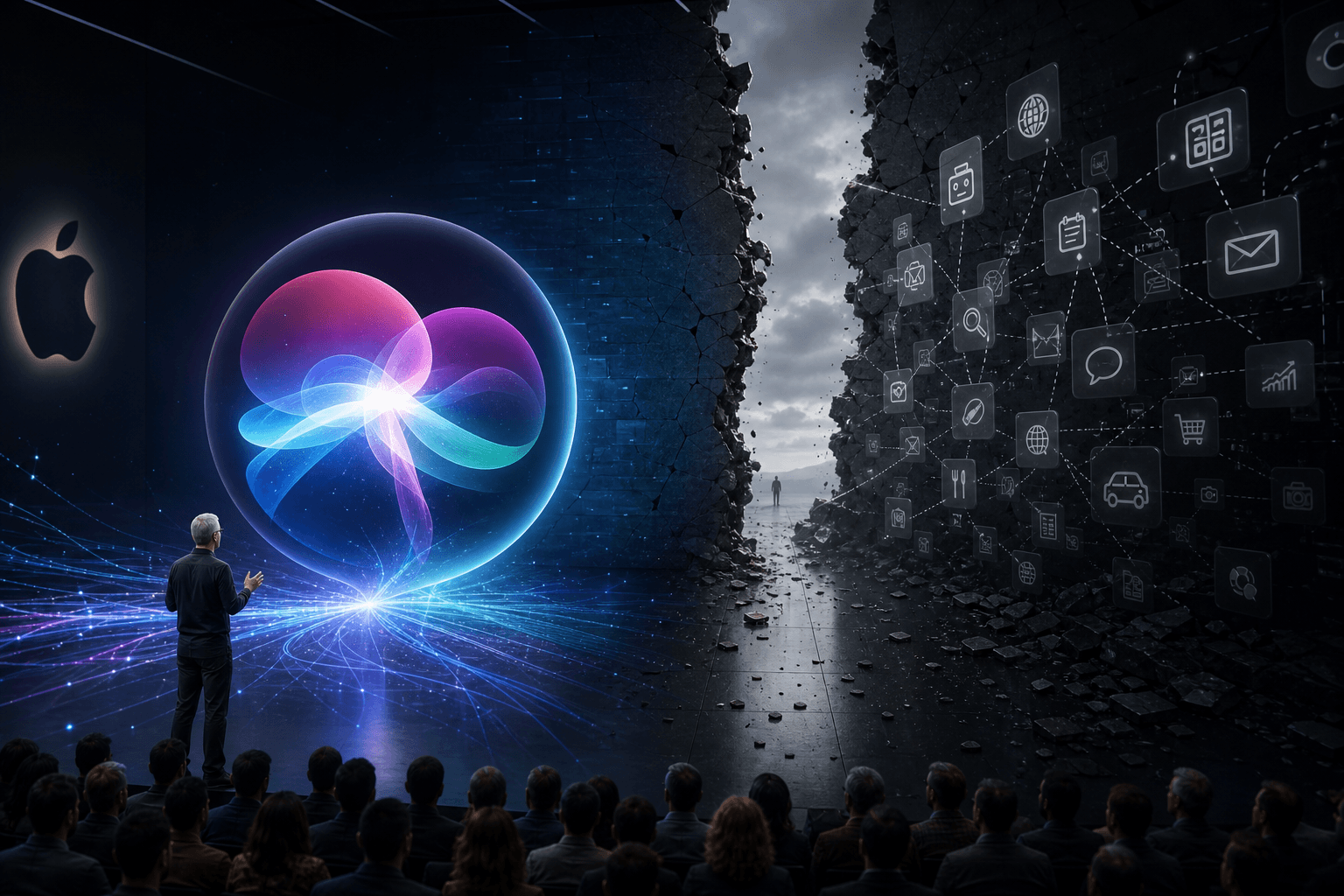

You can now tell Siri AI to change your weak passwords, and it will do it without you specifying each step. That is Apple's first real agentic action, announced at WWDC on June 8 2026. But the Apple AI agent gap persists. Siri AI will not launch in the EU or China at release, limiting the new features to roughly 60% of its global installed base, according to MacRumors.
What Is the AI Agent Gap and Why Does It Apply to Siri?
An AI agent does not wait for your next prompt. It plans and executes multi-step tasks, recovers from errors, and finishes the job without you steering each step. That standard was set by ChatGPT's Operator mode and Gemini's Scheduled Actions in 2025.
The Apple AI agent gap measures the distance between what Siri can hand off autonomously and what rivals complete on their own. Three dimensions matter: task-completion breadth (how many task types), cross-app autonomy (can it move between apps without permission gates at each step), and proactive initiation (can it start a task without a fresh command).
For everyday users this gap shows up as friction. You ask Siri to pull a date from your calendar, book a dinner, and confirm. Siri stops and asks again. You reach for ChatGPT instead. That switch is the gap made visible. Builders designing iOS workflows in 2026 will hit this ceiling fast. Understanding where the ceiling sits is more useful than cheering or dismissing the rebrand.
What Did Apple Actually Announce for Siri AI at WWDC 2026?
Apple rebranded Siri as Siri AI at WWDC 2026 and gave it a standalone app with persistent conversation history across iPhone, iPad, and Mac. New capabilities include multi-turn conversations, personal context from your calendar and email, on-screen visual awareness, and cross-app task actions built on the App Intents framework.
Apple's first demonstrated agentic action is specific and worth noting. The Passwords app now uses Apple Intelligence to navigate to websites and change insecure passwords without you specifying each step. That is a genuine agentic loop: goal set, steps executed, outcome delivered.
Apple also announced a Gemini integration alongside the rebrand, a signal that even Apple now relies on a third-party model partnership to fill gaps in its own assistant. The rebrand is not cosmetic. But the first agentic action is narrow, covering one workflow inside one managed app rather than open-ended execution across your device or the web.
How Does Siri AI Compare to ChatGPT and Gemini on Agentic Tasks?
ChatGPT (GPT-5.5) and Gemini 3.1 Pro offer broad agentic execution across dozens of app categories and web surfaces today. Siri AI's first agentic use case covers one workflow inside a managed system app.
9to5Google's June 8 comparison found Siri AI strongest on device-level control and personal context drawn from the Apple ecosystem, while Gemini leads on live search grounding and multimodal reasoning. The two assistants do not overlap neatly in capability.
Apple's App Intents architecture requires developers to define each agentic action individually inside their apps. Rivals execute general-purpose tasks without app-specific scaffolding. In practice: Siri AI needs a developer-defined hook; ChatGPT and Gemini will attempt the task regardless. For current model rankings across task complexity, see State of LLMs June 2026.
A five-task head-to-head on iOS 27 beta, GPT-5.5, and Gemini 3.1 Pro is planned for this post. That test requires the iOS 27 public beta. Results and screenshots will be added at beta release.
Why Did Apple Fall Behind on AI Agents in the First Place?
Siri launched in 2011 on rule-based intent parsing. Rebuilding that codebase to support large-model reasoning required a full architectural rewrite. Apple only publicly acknowledged the depth of that debt in 2024. WWDC 2026 marks a partial completion, not the end.
Apple's privacy-first, on-device design is a real constraint. Broad agentic reasoning needs substantial cloud compute. Apple's Private Cloud Compute routes sensitive tasks through verified server clusters, which limits throughput compared to OpenAI and Google's unconstrained cloud inference. Privacy and agent capability pull against each other structurally.
Organizational structure added drag. Multiple Apple AI teams worked in parallel rather than toward a unified agent stack. OpenAI and Google shipped iteratively across 2024 and 2025, compounding small improvements into broad capability. Apple's unified layer arrived later. Seeing AI agent cost per successful task shows how that compound gap translates to real product trade-offs when builders choose between platforms.
Why Are Siri AI Features Missing in the EU and China?
Apple confirmed at WWDC 2026 that Siri AI will not be available in the EU or China on iOS or iPadOS at launch. MacRumors reported that EU regulators under the Digital Markets Act require AI systems to have broad device access and act autonomously on that access. Apple argues that requirement creates security risks and proposed a "Trusted System Agent" model as a fix. The European Commission rejected the proposal.
China's exclusion is described as working through regulatory requirements, with no public timeline given.
Features blocked on iOS and iPadOS in the EU include the new Siri app, expanded Visual Intelligence, integrated writing tools, and the camera Siri mode. macOS 27 and watchOS 27 retain Siri AI in the EU, which softens but does not remove the gap.
Builders shipping iOS products in European markets should not plan product features around Siri AI agentic actions for the rest of 2026. Design your agent stack with third-party fallback from day one.
Can Apple Close the Agent Gap and What Should Users Do Now?
Apple's Private Cloud Compute architecture, expanding with iOS 27, gives Apple a credible path to cloud-assisted reasoning with privacy claims intact. The Gemini partnership buys model quality Apple cannot build fast enough on its own. Those two moves point to a real closure strategy for the Apple AI agent gap, even if the timeline is long.
Most estimates place Siri AI at 12 to 18 months away from matching the breadth of agentic execution available today in ChatGPT Operator or Gemini. That window may compress if App Intents ecosystem adoption accelerates after WWDC 2026.
The practical 2026 setup for power users and builders: use Siri AI for device control, personal context, and native Apple ecosystem tasks where integration depth is unmatched. Use ChatGPT or Gemini for autonomous multi-step workflows that cross apps or touch the open web. For memory and context handling across agent platforms, How to Give Your AI Agent Long-Term Memory with MCP will help you wire the right tool to the right job. For a full picture of where top reasoning models sit today, Claude Opus 4.7 Features, Benchmarks and Pricing Explained maps the field clearly.
Test your five most important agentic tasks against both Siri AI and a third-party model before you commit to any production setup. The gap is narrowing. It has not closed yet.
FAQ
What is the AI agent gap Apple is facing with Siri?
The AI agent gap refers to the difference between what Siri AI can do and what platforms like ChatGPT Operator and Google Gemini can do autonomously. An AI agent plans a sequence of steps, executes them across apps or web services, and adapts without the user prompting each move. As of WWDC 2026, Apple shipped its first narrow agentic action: the Passwords app autonomously visiting websites to change insecure passwords. That is one bounded use case. ChatGPT and Gemini support general-purpose agentic task execution across dozens of domains. That difference in breadth and flexibility is the gap.
Did Apple fix Siri at WWDC 2026?
Apple made real improvements at WWDC 2026. Siri was rebranded as Siri AI and gained multi-turn conversation, personal context from calendar and email, on-screen visual awareness, and a new standalone app with conversation history. Apple also shipped its first agentic feature via the Passwords app. These are meaningful upgrades from earlier Siri versions. However, the agentic capability remains narrow and use-case specific compared to ChatGPT and Gemini, which offer general-purpose agent execution. The gap narrowed in one lane. It did not close across the board.
Why is Siri AI not available in the EU?
Apple confirmed at WWDC 2026 that Siri AI will not launch in the EU or China at release. The EU's Digital Markets Act imposes interoperability and data-handling obligations that create tension with Apple's Private Cloud Compute privacy architecture, which routes certain AI tasks to Apple's servers under strict isolation guarantees. Rather than modify that architecture to meet regulatory requirements before launch, Apple chose to exclude the EU and China initially. A timeline for EU availability has not been confirmed. This affects hundreds of millions of iPhone users in two of Apple's largest markets.
How does Siri AI compare to Google Gemini in 2026?
After WWDC 2026, Siri AI leads Gemini in one area: deep iOS device control and personal Apple ecosystem context, including calendar, email, and on-device app actions. Gemini 3.1 Pro leads in live search grounding, multimodal reasoning over large documents, and broad agentic task execution across web and third-party services. Apple also announced a Gemini integration alongside the Siri AI rebrand, acknowledging that its own model is not yet sufficient for all use cases. For device-native tasks, Siri AI is the better fit. For open-ended research, multi-step web tasks, or media work, Gemini remains stronger.
What should iPhone users do while waiting for Siri to catch up on AI agents?
The practical 2026 setup is to use Siri AI for what it does best: controlling your iPhone, setting reminders, sending messages, and leveraging personal context from your Apple account. For multi-step agentic work such as research, document summarization, drafting and sending content, or autonomous task chains, use ChatGPT (GPT-5.4) or Gemini 3.1 Pro, both of which have strong iOS apps with Shortcuts and share-sheet integration. You do not have to replace Siri entirely. Stack it with a general-purpose agent app and route tasks to whichever tool completes them with fewer prompts.