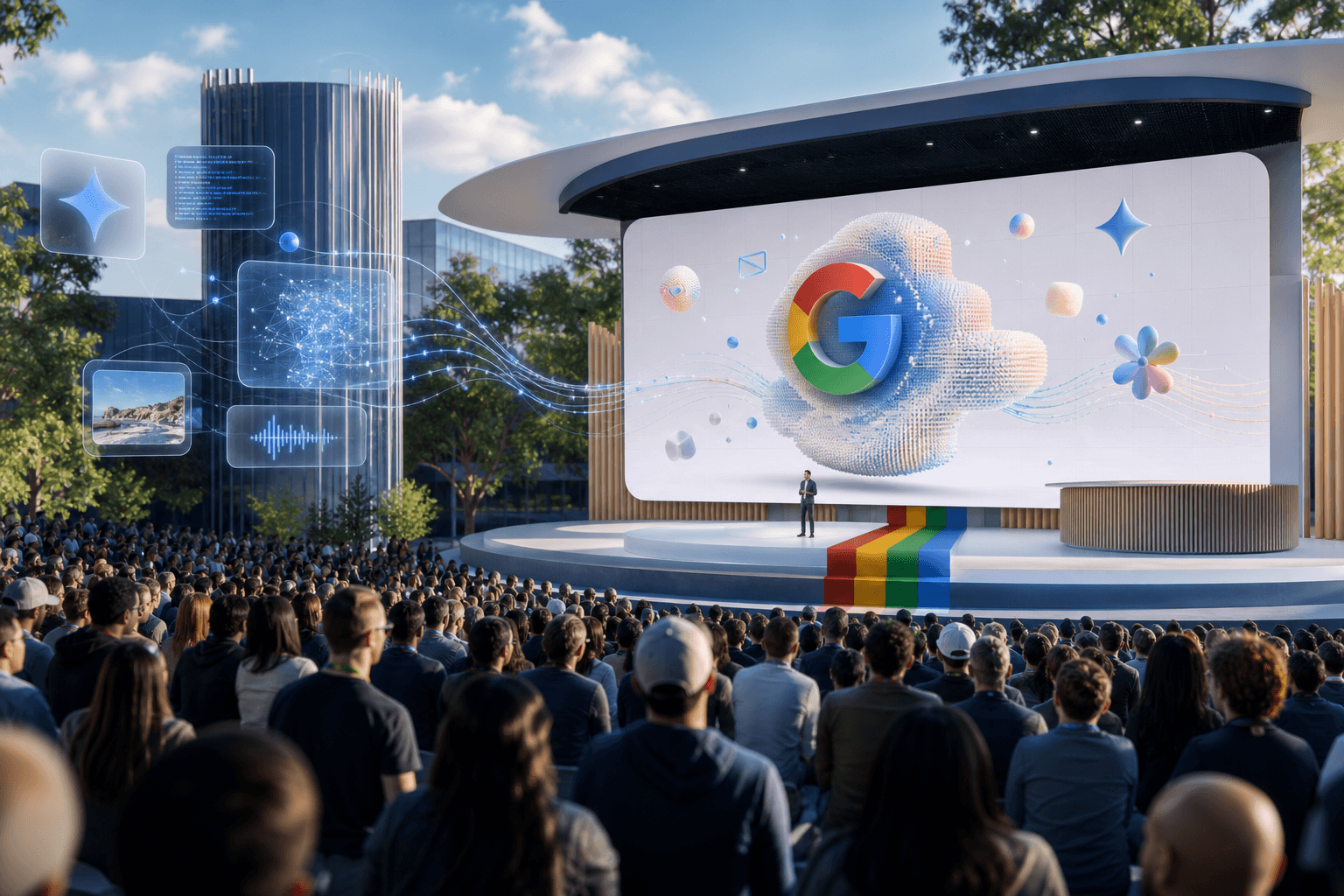

Builders and operators who track AI tools: Google I/O 2025 AI announcements covered more than 100 distinct updates in two days. AI Overviews now reach 1.5 billion users across 200-plus countries and 40-plus languages, up from a U.S.-only rollout just 12 months prior, according to Google's I/O 2025 keynote. The practical question is not what Google announced. It is what is live today, what sits in Labs, and what is still a roadmap promise. This page applies that filter to every major release so you can act on Google I/O 2025 AI announcements without spending a week reading product blogs.
What Is Google I/O 2025 and Why Does the Scale of It Matter?
Google held its annual developer conference at Shoreline Amphitheatre on May 20-21, 2025. More than 100 distinct AI updates landed across Search, models, hardware, video, and developer tools. That is not a typo.
The through-line was Gemini 2.5 Pro as the backbone. Nearly every product announcement traced back to a Gemini model upgrade rather than a standalone feature built in isolation. That matters because it means the stack compounds. A better model at the center improves every surface at once.
The volume also signals a strategic shift. A year ago, Google was playing catch-up after the ChatGPT moment. At I/O 2025, the announcements covered coordinated AI-first execution across the full Google product surface, from Search to glasses to coding agents.
Most coverage lists the announcements in order of presentation. That is not useful for practitioners. The filter that matters is simple: live, Labs, waitlist, or roadmap. Every section below applies that label.
How Does Gemini Deep Think Mode Work and What Can It Actually Solve?
Deep Think uses parallel reasoning. Instead of a single chain of thought, the model explores multiple solution paths at the same time before committing to an answer. Think of it as running several drafts in parallel, then picking the strongest one.
The results at formal math competitions are measurable. At the 2025 International Mathematical Olympiad, an advanced Gemini Deep Think build scored 35 out of 42 points, hitting the gold-medal threshold within the standard 4.5-hour competition window. On USAMO, independent evaluators at Epoch AI measured a 69.0% score on the official problem set and 61.1% on a novel holdout set, confirming the result generalizes beyond competition training data.
For practitioners, the relevant use cases are multi-step code debugging, legal document analysis, and financial modeling. These are tasks where single-pass LLM reasoning fails not because the model lacks knowledge, but because the problem has too many valid paths to explore sequentially.
Status: available in Gemini Advanced today.
What Did Google Change About Search at I/O 2025?
AI Mode is rolling out to all U.S. Search users. It delivers a conversational interface with follow-up questions and file or image attachments. This is distinct from AI Overviews, which are the summaries already visible above the blue links in standard results.
Deep Search brings research-grade synthesis into AI Mode Labs. It is comparable to Gemini Advanced's Deep Research feature but surfaced directly inside a Search query rather than a separate tool.
Project Mariner's agentic capabilities are being piped into AI Mode. This covers booking tickets, restaurant reservations, and local appointments without leaving the search result page. These agentic booking features sit in Labs for now.
Google's own data from the keynote shows queries where AI Overviews appear produce a 10% increase in Search usage overall. That is a retention signal, not a deflection signal. Users are searching more, not bouncing to other tools.
If you run SEO, this changes the content brief. Query intent now matters more than keyword density. Building SEO reports with Google Search Console data becomes more important as AI Mode shifts which queries ever reach the blue links.
How Does Veo 3 Change AI Video Generation?
Veo 3 outputs 4K video with synchronized audio including realistic dialogue, ambient sound, and sound effects, all generated from the same text prompt. No commercial video model had shipped this before the I/O 2025 announcement.
That last point matters more than the resolution. AI video has had a silent-clip problem since the beginning. Every workflow that used Runway, Sora, or earlier Veo versions required a separate audio post-production step. Veo 3 collapses that into a single generation call.
The Flow platform adds production controls: camera angles, object manipulation, and scene transitions via text directives. Google premiered four short films made with Veo on Flow TV at I/O, giving the first public proof artifacts for evaluating real output quality rather than cherry-picked demos.
For content teams and solo operators, the practical test is straightforward. Take a prompt you have already run through your current video tool, run it in Veo 3, and measure the time saved on audio sync alone. That gap is where the cost calculation changes.
If you want a direct quality comparison for AI video tools available today, the Runway Gen-4.5 review gives a production-ready benchmark to test against.
What Are Google's AI Smart Glasses and Who Are They For?
Android XR glasses run Gemini natively with a camera, microphones, and speakers but no in-lens display. The design targets ambient AI assistance, not augmented-reality overlays. You look at something, ask a question, and get a spoken answer.
Project Astra powers the real-time visual and conversational responses. Google DeepMind's Gemini updates from I/O 2025 confirm Project Astra has moved from prototype to a public-availability milestone on iOS and Android, so the underlying capability is shipping even before the glasses hardware arrives broadly.
Hardware partnerships with Samsung, Warby Parker, and Gentle Monster are the tell. Those are not developer-kit distributions. They are mainstream fashion distribution channels, which signals Google is targeting mass-market adoption rather than a repeat of the Glass enterprise experiment.
Cross-platform iPhone support is confirmed from launch. That removes the Android-only barrier that limited earlier Android XR hardware reach significantly.
For product teams: treat this as a 12-to-18-month design brief. If your product has a voice surface or a camera surface, start mapping ambient AI interaction patterns now rather than retrofitting them after the hardware ships at scale.
Which Other AI Tools Did Google Ship or Move to Beta at I/O 2025?
Jules, Google's autonomous AI coding agent, entered public beta at I/O 2025. It works asynchronously, which is different from most coding assistants. Jules writes tests, fixes bugs, and reads full repository context without needing a human approval step for each action. If you are evaluating AI coding tools right now, the Cursor vs GitHub Copilot comparison gives a useful baseline for how Jules sits against established tools.
Imagen 4 and Lyria 2 joined Veo 3 on Vertex AI. That gives enterprise developers a unified generative media stack for image, audio, and video under one API surface, reducing the number of vendor relationships needed to run a full media production pipeline.
Gemini Live added native audio output. Voice-first workflows now do not route through text as an intermediate format. That closes a latency and naturalness gap that made earlier voice integrations feel clunky in real user testing.
Project Astra is now a shipping product on iOS and Android, not a DeepMind demo. Real-time multimodal assistance, including live visual question answering through a phone camera, is available to test today. That is the cleanest signal of how far the agentic roadmap has actually moved.
What Should Builders and AI Practitioners Do With These Announcements?
Start with what is live. AI Overviews reaching 1.5 billion users across 40-plus languages as of May 2025 is not a future forecast. It is the current baseline your Search strategy runs against today. AI Mode in U.S. Search, Project Astra on mobile, and Jules public beta are all testable without a waitlist.
Test Deep Think on the specific tasks where your current LLM pipeline produces inconsistent outputs. The parallel reasoning architecture fits problems with many valid solution paths. Multi-step debugging, contract review, and scenario modeling are good starting points.
For content and media teams, run a Veo 3 test against your current video workflow. Measure the time your team spends on audio post-production per video. That is the exact cost Veo 3 targets. A controlled test gives you a real number to act on.
For broader AI model context across all the major releases in 2026, the 8 best AI models comparison shows where Gemini 3.1 Pro sits relative to Opus 4.7, GPT-5.5, and the open-weight alternatives. Knowing the landscape helps you assign the right model to the right task rather than defaulting to one tool for everything.
The glasses and agentic Search announcements are 12-to-18-month readiness signals. The builders who design for ambient AI interfaces now will ship before the hardware curve peaks.
Want to earn USD with AI? Join the next free AI Agency® webinar at freedombusiness.io.
FAQ
What was the biggest announcement at Google I/O 2025?
The single most significant announcement was Gemini 2.5 Pro with Deep Think mode, which underpinned nearly every other product update at the event. Deep Think introduced parallel multi-step reasoning, enabling the model to explore multiple solution paths before responding. Beyond the model itself, AI Mode rolling out to all U.S. Search users marked the most visible consumer-facing shift: Google's core product now operates as a conversational AI interface, not just a link index. If you measure by user reach, AI Overviews crossing 1.5 billion monthly users across 200-plus countries is the scale story.
What is Gemini Deep Think mode and how is it different from regular Gemini?
Deep Think is an enhanced reasoning layer built on top of Gemini 2.5 Pro. Standard Gemini produces a response through a single reasoning chain. Deep Think runs parallel chains simultaneously, evaluates them, and synthesizes a final answer from the most promising paths. This makes it significantly more reliable on problems with many possible solution routes, such as advanced mathematics, complex code debugging, or multi-step analysis. The practical evidence is concrete: Deep Think scored 35 out of 42 at the 2025 International Mathematical Olympiad, reaching gold-medal standard within the competition time limit, and 69.0% on USAMO in independent Epoch AI testing.
What is the difference between AI Overviews and AI Mode in Google Search?
AI Overviews are the short AI-generated summaries that appear above traditional blue-link results for eligible queries. They are passive additions to the existing Search layout. AI Mode is a separate, fully conversational search experience where users ask follow-up questions, attach files or images, and receive synthesized answers without a traditional results page. AI Mode also integrates agentic features from Project Mariner, meaning it can take actions like booking reservations or purchasing event tickets. As of May 2025, AI Mode is rolling out to all U.S. Search users, while AI Overviews are already live globally for 1.5 billion users.
What makes Veo 3 different from other AI video generators?
Veo 3's defining feature is native synchronized audio. Earlier AI video tools, including previous Veo versions, Runway, and Sora, produced silent video that required separate audio post-production. Veo 3 generates realistic dialogue, ambient sound, and sound effects directly from the same prompt used to create the video, at 4K output resolution. It also gives filmmakers fine-grained control over camera angles, object manipulation, and scene transitions via text directives. Google premiered four short films made with Veo on its Flow TV platform at I/O 2025, providing the first public quality reference artifacts.
When will Google's AI smart glasses be available to buy?
Google did not confirm a firm consumer release date at I/O 2025 for Android XR glasses. The announcement confirmed hardware partnerships with Samsung, Warby Parker, and Gentle Monster for distribution, and cross-platform iPhone support from launch. The glasses are powered by Gemini and Project Astra, with a camera, microphones, and speakers but no in-lens display. Based on the partnership structure and typical hardware lead times from a May announcement, a late 2025 or early 2026 availability window is the most realistic estimate. Watch for developer hardware programs to open before general retail availability.
What is Jules and how do I get access to the AI coding agent?
Jules is Google's autonomous AI coding agent, announced at I/O 2025 and moved to public beta at the same event. It is designed to operate asynchronously on coding tasks: writing tests, fixing bugs, and understanding full repository context without requiring a human prompt at every step. Unlike Copilot or Gemini Code Assist, which assist in real time inside an editor, Jules works in the background on assigned tasks and returns results. Access is available through the Jules public beta sign-up on Google Labs. It is distinct from Google's other coding tools and targets longer-running, multi-file tasks.
Did Google beat OpenAI and Anthropic at I/O 2025?
Google I/O 2025 narrowed or closed several benchmark gaps with competitors. Gemini 2.5 Pro leads across mathematics, coding, and multimodality benchmarks as of May 2025 according to Google's own data, though independent evaluators like Epoch AI and LMSYS confirm competitive math performance. The IMO gold-medal result for Deep Think is a genuine milestone no competing model had matched under identical competition conditions. However, 'beating' rivals depends on the task. OpenAI's o3 and Anthropic's Claude 3.7 Sonnet remain competitive on coding and reasoning benchmarks. I/O 2025 positioned Google as a co-leader rather than a clear category winner across all dimensions.