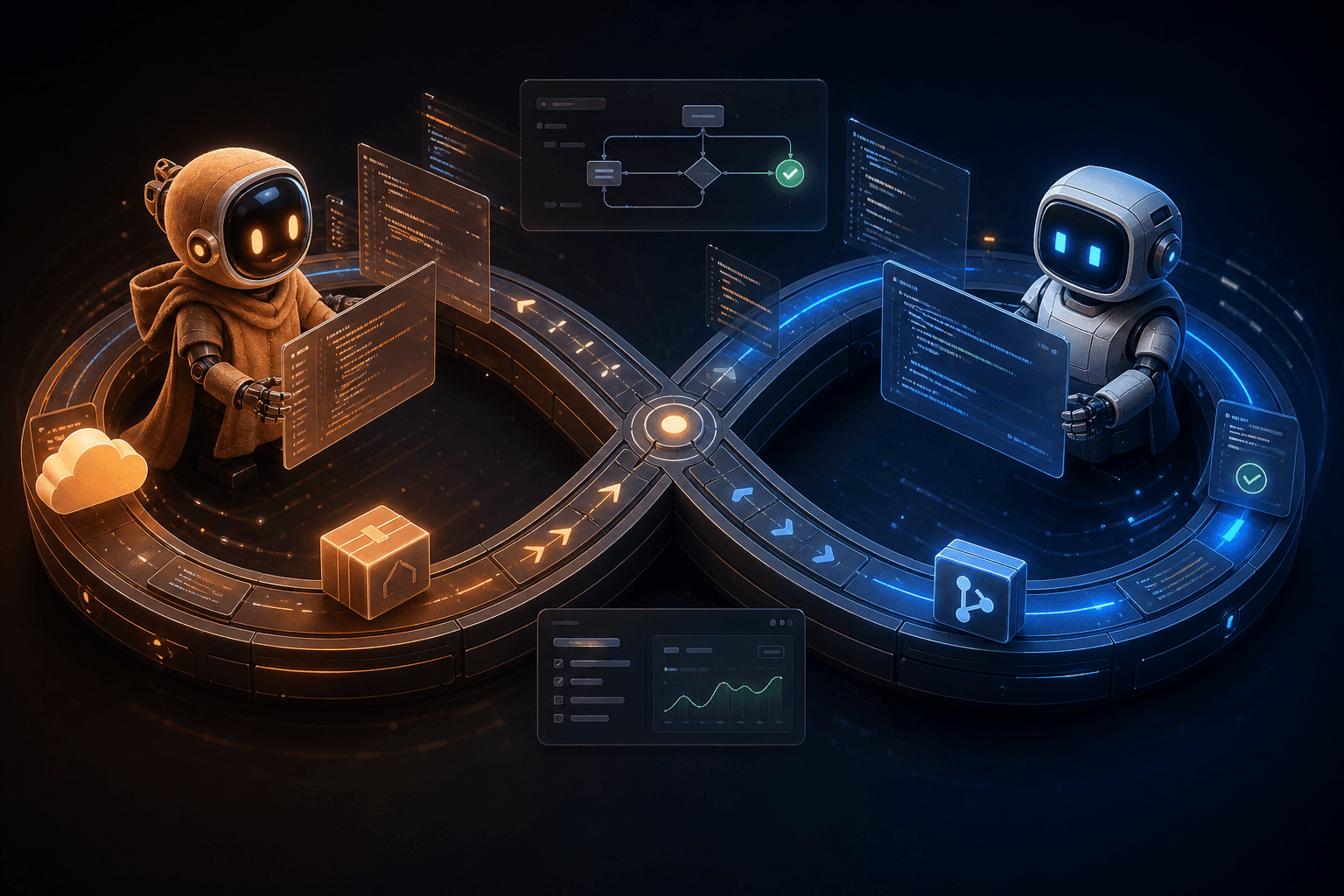

You should treat AI agent loops as repeat work units, not magic agents. AI agent loops help Claude Code and Codex run PR work when each loop has a trigger, goal, tool limits, tests, stop rule, and handoff note. In 2026, AI agent loops matter because coding tools now act more like task runners than chat boxes.
A 2026 arXiv panel study of 5,838 developers linked Claude Code use with plus 41 monthly commits and 1.5 more repos joined, according to Quispe 2026. That does not mean you should let agents roam. It means builders need better loop design.
What are AI agent loops?
AI agent loops are repeated cycles where a coding agent can observe, decide, act, verify, and repeat. The loop is the unit that matters. Not the brand name. Not the agent label. A useful loop has a clear job, a known repo, a tool policy, and a review artifact.
The basic lifecycle is simple: receive a goal, load context, plan the next step, execute a tool, observe the environment feedback, update state, and decide whether to continue. This act-observe-decide cycle is what turns a chat model into goal-based automation. Without that cycle, you have a message thread. With it, you have an agentic workflow that can move through code, tests, logs, and review notes.
There are four common types. A heartbeat loop checks often. A cron loop runs on a set time. A goal loop works until a result is met or blocked. A subagent loop splits work across narrow lanes.
The risk changes by loop type. A heartbeat that reports stale PRs is low risk. A goal loop that edits auth code is not. This is why every loop needs an owner, file bounds, allowed commands, tests, and a stop rule. For the broader tool layer behind these loops, read Model Context Protocol: How MCP Connects AI to Your Tools.
How do heartbeats and crons work?
Heartbeats are small checks that run often. Use them for CI state, stale PRs, queue health, dependency drift, or test flakes. They should read more than they write. Their best output is a short report with links, risk level, and one next step.
Crons are better for batched work. Use them for nightly docs refreshes, low-risk lint fixes, test failure triage, or routine dependency PRs. A cron should have a narrow class of work. If the task needs judgment, make it open a draft PR, not merge.
Set hard budgets. Limit runtime, token spend, file paths, and commands. As of June 2026, Claude Code and Codex are being used less like chat tools and more like task runners with logs, approvals, and repeat sessions. That is useful. It also means a bad loop can become a hidden system if no one owns it.
The message lifecycle matters here. A trigger becomes an input message, the agent turns it into planning steps, each tool execution creates new observations, and those observations become the next turn. Treat turns and messages as the audit trail, not as disposable chat history.
How should goal loops be designed?
Goal loops should start with a testable outcome. Say “make this test pass,” “cut flaky failures in checkout,” or “open a draft PR with screenshots.” Do not say “improve the repo.” The agent needs a finish line before it starts.
A good goal loop has three parts. First, the context package: issue, files, rules, test command, and known traps. Second, the work policy: allowed files, allowed commands, budget, and approval points. Third, the handoff: command log, changed files, test output, failure reason, and next action.
The planning step should be explicit but short. Ask the agent to name the next few moves, then re-plan after feedback from the repo, compiler, test runner, browser, or reviewer. Good loops improve through iterative refinement. They do not guess once and keep pushing after the evidence changes.
Termination conditions should be written before the loop starts. Stop when the test passes, the budget is spent, the allowed files are insufficient, the agent hits a repeated failure, or a human decision is required. A loop without termination conditions is just unattended work.
This is where many teams confuse motion with progress. A long chat is not a durable work record. A strong loop leaves proof.
When should you use subagents?
Use subagents when the work can split cleanly. One agent can handle frontend polish. Another can add backend tests. A third can review a migration. The split should match ownership, not hope. Each subagent needs a narrow job and a file scope.
Do not use subagents to multiply vague prompts. That just makes more cleanup. The hard part is integration. If two agents touch the same files, someone must own the final merge. That can be a lead agent with strict rules, or a human. I prefer a human for risky diffs.
Subagents also need shared context window management. If every agent carries the whole repo, the loop gets expensive and noisy. Give each one the smallest useful packet: task, files, constraints, recent decisions, and expected output. For longer work, summarize the stable facts and drop stale exploration so the next turn is not fighting old context.
As of May 2026, research on Claude Code has focused on the system around the loop, including permissions, compaction, hooks, subagents, and session storage, as shown in Dive into Claude Code. The field note still needed here is simple: one PR where subagents helped, and one where overlap caused cleanup.
How do Claude Code and Codex differ in practice?
Claude Code and Codex differ at the interface layer. Claude Code leans into local CLI work, hooks, permissions, subagents, and repo sessions. Codex leans into task sessions, approvals, changed files, command logs, and reviewable handoff. Both can run useful PR loops if you design the loop first.
Use the same operator model for both. Define the trigger, context package, tool policy, work budget, verification, and handoff. Then map that model into each tool. Claude Code may express it through hooks and local rules. Codex may express it through task prompts, approvals, and command history.
Keep tool-specific parts tool-specific. Permission modes, shell access, session history, and environment setup should not be copied blindly. For a direct comparison of coding tools, see Codex vs Claude Code: Which AI Coding Tool Wins in 2026.
AI coding agents are strongest when they can use tools against real project state. Reading files, running tests, applying patches, checking screenshots, and reporting failures are all part of the loop. The model is only one layer. The surrounding tool execution, environment feedback, and review surface decide whether the work is usable.
Why do permissions and review gates matter?
Permissions are product design. A coding loop can edit files, run shell commands, call services, and open PRs. That is real power. It needs real bounds. Start with read-only loops that report. Then allow low-risk edits. Keep broad rewrites, deploys, secrets, and infra changes behind approval.
As of April 2026, permission-gate research showed that ambiguous DevOps tasks remain high risk, especially when file edits can bypass shell-command gates, according to Measuring the Permission Gate. This matters in SEA teams too, where small teams often give one tool access to many systems.
Humans should own merge calls, prod changes, security-sensitive diffs, and customer-facing copy. The agent can prepare the work. It can test. It can write the handoff. But the merge decision should stay with the person who carries the blast radius.
Add an evaluation layer before you expand permissions. Track whether the loop produced a useful artifact, whether tests were meaningful, whether review time went down, and whether failures were caught early. Memory systems can help here if they store stable repo rules, previous failure modes, and team preferences. They should not become an excuse to keep unsafe history or bypass review.
How do you ship a no-babysitting PR loop?
Start with one repo, one trigger, one metric, and one narrow PR class. Good first loops include flaky test triage, docs drift, lint fixes, or screenshot updates. Do not begin with auth rewrites or deploy flows.
Build the loop around proof. Use lint, tests, type checks, coverage, screenshots, or benchmark deltas. Make the agent leave a PR checklist with prompt, plan, commands, changed files, test output, and known risk. This also helps cost control, which pairs well with AI Agent Cost Per Successful Task: What You Pay in 2026.
Move in stages. Advisory mode first. Draft PRs next. Limited autonomous PRs only after you measure false positives, noisy reports, review time, and recovery cost. For the next build, use the loop spec: trigger, goal, allowed files, allowed commands, test command, stop rule, escalation rule, and PR checklist. Then run one loop on real work and review the artifact before adding another.
FAQ
What is an AI agent loop in coding work?
An AI agent loop is a repeatable cycle where the agent observes a state, decides what to do, acts through tools, verifies the result, and either stops or repeats. In coding work, that state might be a failing test, stale PR, dependency update, issue queue, or scheduled maintenance task. The loop matters because it turns a one-off chat prompt into an operating system for repeated work. A good loop names the trigger, the goal, the repo context, the allowed tools, the verification command, and the stop rule. Without those pieces, the agent is just improvising.
What is the difference between a cron loop and a goal loop?
A cron loop starts because time passed. For example, every weekday at 8 a.m. the agent checks failing CI jobs and drafts a triage note. A goal loop starts because an outcome has been assigned. For example, the agent must make one failing test pass and open a draft PR. Cron loops are useful for monitoring, cleanup, reporting, and recurring low-risk maintenance. Goal loops are better for bounded delivery work with acceptance criteria. The practical difference is the stop condition: cron loops stop after a scheduled pass, while goal loops stop when the goal is met, blocked, or outside the approved scope.
When should I use subagents in Claude Code or Codex?
Use subagents when the work can be split into independent scopes with clear ownership. Good examples include one agent reviewing tests, another updating documentation, and another checking a frontend screenshot. Bad examples include three agents editing the same files without an integration owner. Subagents help when they reduce waiting time or bring specialized review passes to a task. They hurt when they multiply vague instructions, create merge conflicts, or produce disconnected recommendations. The operating rule is simple: give each subagent a narrow brief, a disjoint file or responsibility boundary, and a concrete output that the lead agent or human can inspect.
Can AI coding agents safely run without babysitting?
They can run with less manual supervision, but not without boundaries. The safe version is a bounded loop that works inside a known repo, uses approved commands, writes reviewable diffs, runs deterministic checks, and stops when it reaches a budget or ambiguity threshold. Humans should still own merge decisions, production changes, credentials, deployment, and broad architectural calls. The aim is to stop babysitting routine steps, not to remove accountability. A useful autonomous loop should make review easier by leaving evidence: what it tried, what changed, what passed, what failed, and what still needs judgment.
How should I design the first AI agent loop for a team?
Start with a narrow workflow that already has a clear manual checklist. Good first candidates are flaky test triage, dependency update PRs, broken link fixes, type error cleanup, or CI failure summaries. Define the trigger, scope, allowed files, allowed commands, verification step, and stop rule in writing. Run it in advisory mode first, where the agent reports what it would do. Then let it open draft PRs after the team is comfortable with its accuracy and noise level. Measure review time, false positives, failed runs, and rollback rate before expanding the loop to broader work.
Do Claude Code and Codex need different agent loop designs?
The product mechanics differ, but the loop design should be consistent. Claude Code and Codex expose different interfaces for sessions, permissions, command execution, review artifacts, and delegation. The operator model is the same: decide what triggers the loop, package the right context, constrain tool access, define the goal, verify the result, and produce a human-readable handoff. Treat tool-specific features as implementation details. The durable asset is the loop spec, because it can move across tools as teams change vendors, models, IDEs, and repository workflows.
Sources
- How to design AI agent loops: schedules, goals, and subagents in Claude Code and Codex
- Dive into Claude Code: The Design Space of Today's and Future AI Agent Systems
- Measuring the Permission Gate: A Stress-Test Evaluation of Claude Code's Auto Mode
- Coding Beyond Your Training: Claude Code and the Technological Frontier of Software Developers