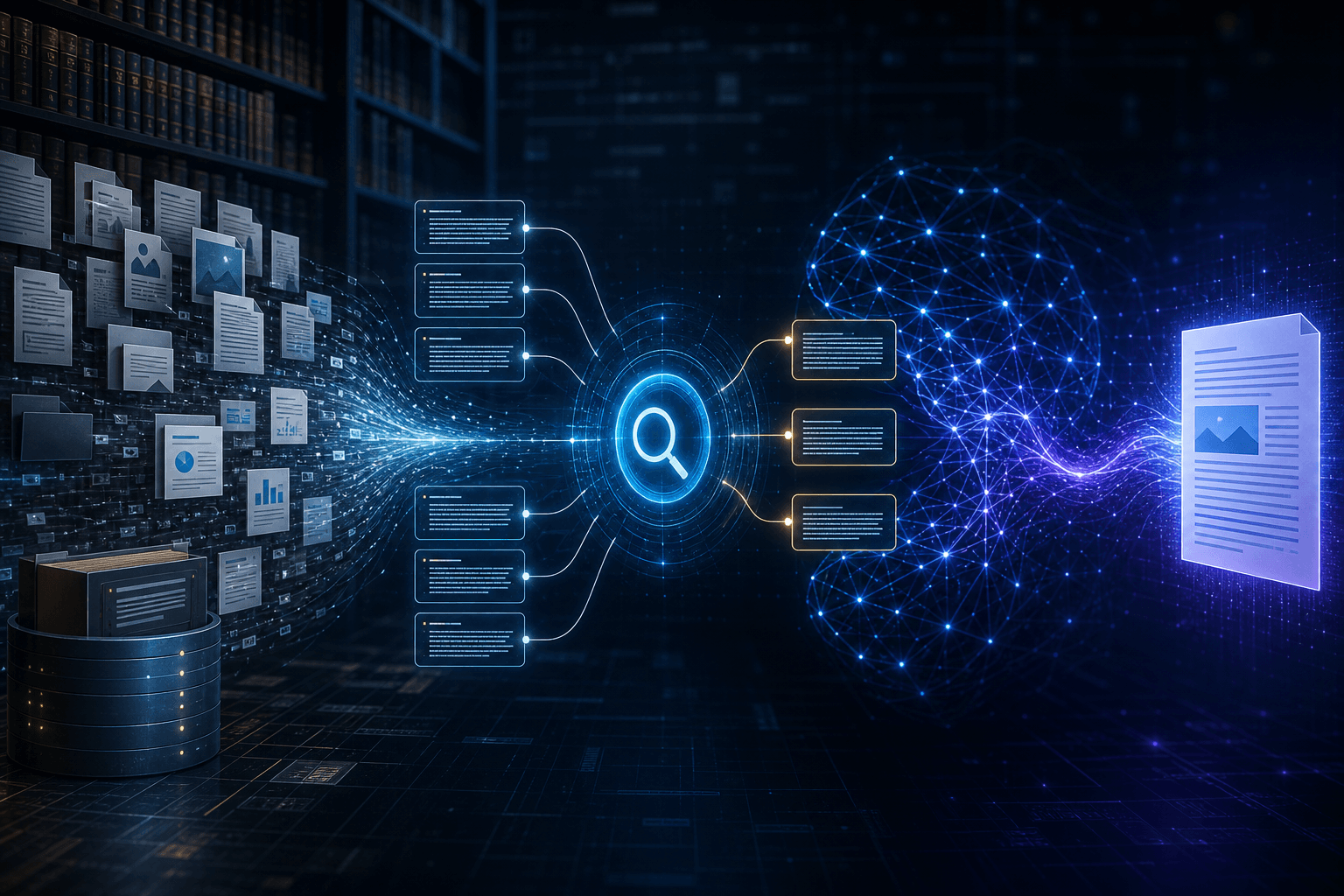

Builders shipping AI products in 2026 face a simple problem: language models do not know your data. Retrieval Augmented Generation (RAG) fixes this. It connects a model to your documents at query time, so answers stay current and grounded. According to Menlo Ventures' 2024 State of Generative AI report, 73% of enterprise generative AI deployments now use some form of RAG, up from 31% in 2023. The pattern works. Here is how it works, when to use it, and how to avoid the mistakes that sink most first attempts.
What Is Retrieval Augmented Generation (RAG)?
RAG is a pattern that pairs a language model with an external retrieval step. The model can reference documents it was never trained on. Instead of retraining a model (expensive) or stuffing everything into a prompt (limited), RAG retrieves only the relevant pieces at query time and feeds them as context.
The term comes from Meta AI researchers (Lewis et al., 2020) who showed that combining a retriever with a generator outperformed either alone on knowledge-intensive tasks. Today it is the default architecture for enterprise AI assistants, internal search tools, and customer support bots.
Think of RAG as giving a model an open-book exam. The model is still smart. But now it has the right textbook pages in front of it. This matters because pure prompting cannot fit your entire knowledge base into one call, and fine-tuning bakes in static knowledge that goes stale. RAG keeps answers fresh without touching model weights.
Why Do LLMs Need External Retrieval?
Every language model has a training cutoff. It cannot know what happened after its last data snapshot. Your product changelog from last week does not exist in any foundation model. Neither do your internal support tickets, proprietary databases, or compliance documents.
Hallucination is the direct cost of this gap. Without grounding, models confabulate. They fill knowledge gaps with plausible-sounding fiction. RAG reduces this by giving the model something real to cite. When the retrieved text says "pricing changed on March 3," the model repeats that fact instead of guessing.
Cost matters too. Updating a vector index takes minutes and costs pennies. Fine-tuning a foundation model takes hours and costs hundreds to thousands of dollars per run. As of May 2026, context windows have expanded to 1M+ tokens for some models, but enterprise RAG adoption continues to grow because most corporate knowledge bases far exceed even those limits. A mid-size company with 50,000 support tickets and 2,000 product docs cannot fit that into a single prompt, regardless of window size.
How Does a RAG Pipeline Work Step by Step?
A RAG pipeline has four stages: ingestion, retrieval, augmentation, and generation. A diagram showing the flow (User Query > Embedding > Vector Search > Retrieved Chunks > LLM Prompt > Grounded Answer) helps visualize this.
Ingestion. Chunk your documents into passages of 300 to 500 tokens. Generate embeddings with a model like OpenAI's text-embedding-3 or open-source alternatives like BGE or E5. Store vectors in a database like Pinecone, Weaviate, Qdrant, or the open-source Chroma.
Retrieval. When a user asks a question, embed that question with the same model. Run a similarity search (cosine or dot product) against your vector store. Pull the top-k most relevant chunks, typically 3 to 10.
Augmentation. Inject retrieved chunks into the LLM prompt as context. Add instructions: "Answer only from the provided sources. If the answer is not in the sources, say so."
Generation. The LLM produces a grounded answer. Optionally, add a citation layer that maps each claim back to its source chunk. As of May 2026, Anthropic's Claude, OpenAI's GPT-4.1, and Google's Gemini all offer native tool-use features that simplify the retrieval step, letting models call your search index directly as a tool.
What Are Common RAG Mistakes to Avoid?
Most RAG pipelines fail not at the model layer but at the retrieval layer. Here are the mistakes that sink teams before they ship.
Chunking too aggressively. Tiny fragments lose context. A 50-token chunk about "pricing" without the surrounding product name is useless. Start with overlapping chunks of 300 to 500 tokens with a 50-token overlap between consecutive passages.
Ignoring retrieval quality. Garbage in, garbage out. If retrieval returns irrelevant chunks, the LLM will confidently use them anyway. It does not know the chunks are wrong. It just sees "context" and runs with it.
Skipping evaluation. You need to measure retrieval recall and answer faithfulness separately. Tools like Ragas and DeepEval provide automated scoring. Treat this as your checklist: prepare 20 question-answer pairs from your own docs, score retrieval precision at top-5, and score answer faithfulness independently.
Over-engineering early. Start with naive RAG (embed, retrieve, generate) before adding rerankers, query expansion, or agentic retrieval loops. Complexity without measurement is just cost.
RAG vs. Fine-Tuning vs. Long Context: Which Should You Use?
The decision is not "which is best" but "which fits your constraints."
RAG is best when knowledge changes frequently (weekly or faster), when your corpus exceeds context window limits, or when you need source citations. Cost is low per query. Data stays in your own infrastructure.
Fine-tuning is best when you need the model to adopt a consistent style, tone, or narrow domain vocabulary. It bakes knowledge into weights. Updates require retraining. It works for stable, slow-changing domains like medical coding or legal clause classification.
Long context (200k+ tokens) reduces the need for retrieval on small corpora. But it costs more per call, has higher latency, and still cannot reach private data the model never sees. It works for one-off analysis of a single large document.
In practice, many production systems combine approaches. A company might fine-tune for tone, use RAG for knowledge, and pass a long-context window for the current conversation thread. The key is knowing which layer handles which job. If your data changes monthly, RAG is non-negotiable. If your data fits in 100k tokens and never changes, long context alone might work. Most real deployments are not that simple.
How Do You Build a Basic RAG System Today?
You can build a working RAG pipeline in an afternoon with open tools. Here is the minimum viable stack.
Tools. Pick a framework: LangChain or LlamaIndex. Both handle chunking, embedding, and retrieval orchestration. Pick a vector store: Chroma for local development, Pinecone or Weaviate for production. As of early 2026, vector database startup funding has exceeded four billion dollars cumulatively, with Pinecone, Weaviate, and Qdrant each raising major rounds since 2024. The tooling is mature.
Steps. Load your documents (PDFs, markdown files, database exports). Chunk them. Embed chunks. Store in your vector DB. Write a retrieval function that takes a query, embeds it, and returns top-5 chunks. Write a generation function that formats those chunks into a prompt and calls your LLM of choice (Sonnet 4.6, GPT-5.5, or Gemini 3.1 Pro all work well). Return the answer.
Testing checklist before you scale:
- Prepare 20 question-answer pairs from your own documents.
- Run each question through your pipeline.
- Score retrieval: did the correct source chunk appear in the top-5 results?
- Score faithfulness: does the generated answer match the source, with no added claims?
- Fix retrieval failures first. Only then tune generation prompts.
Use this checklist as your validation framework.
How Do You Pick a Vector Database for RAG?
The vector database is your retrieval engine. It stores embeddings and runs similarity search at scale. Three factors matter most: latency at your expected query volume, filtering support (metadata filters let you scope searches to specific doc types or dates), and managed vs. self-hosted preference.
For most teams starting out, Chroma runs locally with zero config. For production, Pinecone offers fully managed hosting with low ops burden. Weaviate and Qdrant give more control and can run on your own infrastructure. All four integrate with LangChain and LlamaIndex in under 10 lines of code.
Do not over-optimize the database choice early. A working pipeline with Chroma locally beats a perfectly architected system that never ships. Migrate to a managed solution when latency or scale demands it. The embedding format is portable across all major vector stores.
What Should You Build Next?
RAG is the most practical way to make a language model useful with your own data. Start with a simple embed-retrieve-generate pipeline. Measure retrieval quality and answer faithfulness separately. Add complexity only when the simple version fails.
If you want to go deeper on the tools that power RAG pipelines, read our guide on how to build AI automation workflows with n8n or explore the Model Context Protocol guide to see how AI connects to your existing tools. For model selection, our 8 best AI models in 2026 comparison covers the LLMs you would plug into a RAG pipeline. And if cost is a concern, check how to reduce AI API costs without changing your code.
Want to earn USD with AI? Join the next free AI Agency® webinar at freedombusiness.io.
FAQ
What is RAG in simple terms?
RAG (Retrieval Augmented Generation) is a technique where a language model looks up relevant documents before answering a question. Think of it like an open-book exam: instead of relying only on what the model memorized during training, it searches a knowledge base, pulls the most relevant passages, and uses them as context to generate a grounded answer. This means the model can work with private company data, stay current after its training cutoff, and reduce hallucinations because it has real text to reference.
How is RAG different from fine-tuning a model?
Fine-tuning changes the model's weights by training it on new data, which is expensive and makes the model better at a style or narrow task but does not reliably inject facts. RAG leaves the model unchanged and instead retrieves relevant documents at query time, injecting them into the prompt. RAG is better for frequently changing knowledge (like product docs or support tickets). Fine-tuning is better for teaching the model a consistent tone or domain vocabulary. Many production systems use both together.
What vector database should I use for RAG?
For prototyping, open-source options like Chroma (runs locally, no setup) or FAISS (Facebook's library) work well. For production workloads, managed services like Pinecone, Weaviate, or Qdrant offer scaling, filtering, and monitoring out of the box. Postgres with the pgvector extension is a strong choice if your data is already in Postgres and you want to avoid adding another service. The database matters less than your chunking strategy and embedding model quality.
How do I know if my RAG pipeline is working correctly?
Evaluate two things separately. First, retrieval quality: are the right chunks being returned? Measure this with retrieval recall (did the correct source document appear in the top-k results). Second, answer faithfulness: does the LLM answer match what the retrieved documents actually say? Tools like Ragas and DeepEval automate both measurements. Start with 20 manually verified question-answer pairs from your own documents and score your pipeline against them before scaling.
Do I still need RAG if my model has a million-token context window?
Usually yes. A million-token window holds roughly 750,000 words, which sounds like a lot, but many corporate knowledge bases contain millions of documents. Stuffing everything into the context window is also expensive (you pay per token) and slower. RAG retrieves only the relevant handful of passages, keeping costs low and latency fast. Long context is useful when your entire corpus is small enough to fit, like a single long contract or a short manual.