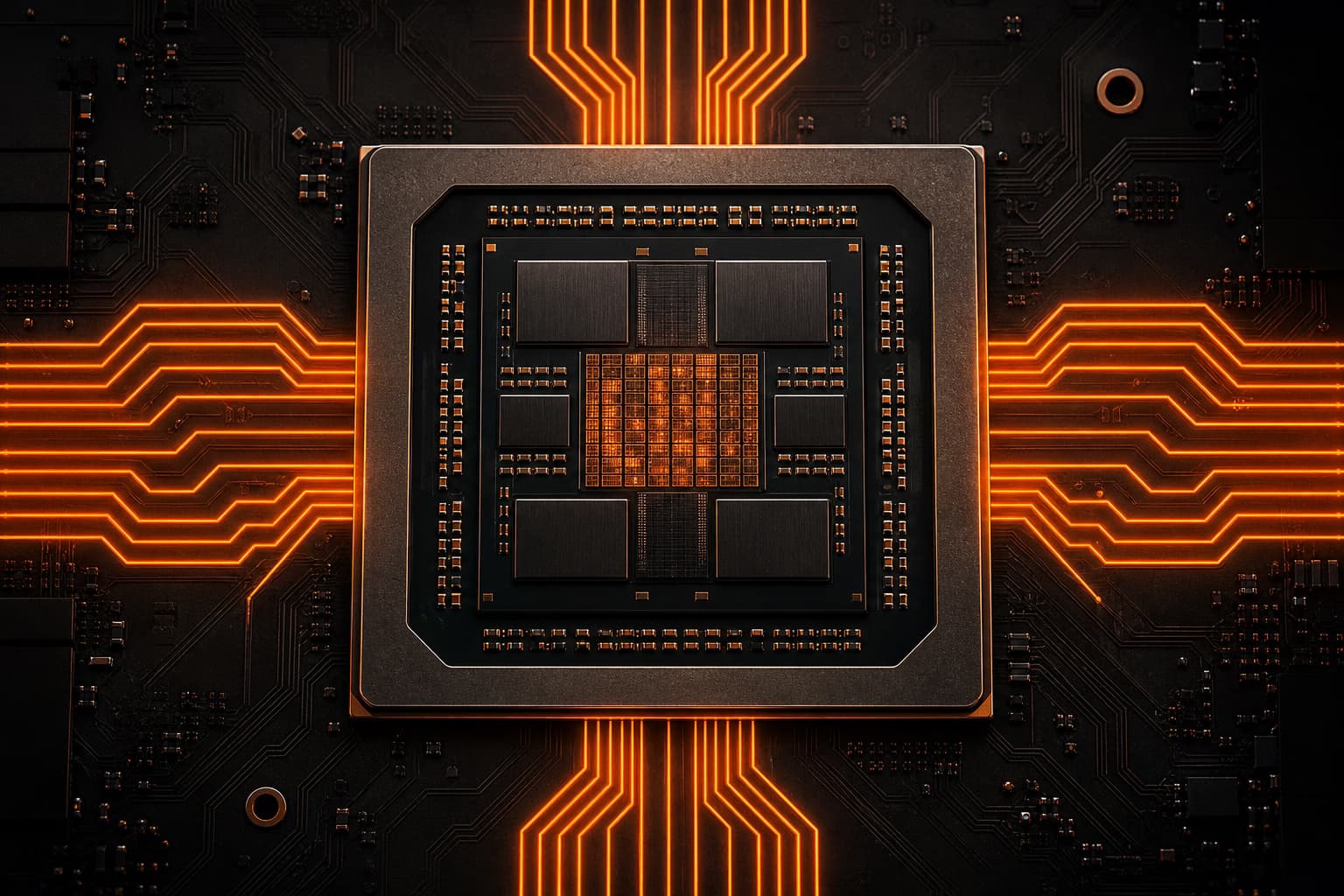

The AMD Strix Halo refresh leaks point to a Ryzen AI Max+ Pro APU with a 16-core Zen 5 CPU and 64GB of unified LPDDR5X memory. That puts workstation-class local AI inside a single consumer chip, collapsing the discrete GPU plus VRAM model that has defined AI hardware since 2022. Running 70B-class models at home moves from a multi-GPU build to a mini PC next to your monitor.
What did AMD's leaked refresh actually reveal?
The May 2026 dev.to leak describes a Ryzen AI Max+ "Pro" SKU with 16 Zen 5 cores, integrated RDNA 3.5 graphics, and a 64GB LPDDR5X unified memory pool. None of this is official. AMD launched the original Strix Halo platform as Ryzen AI Max+ 395 at CES in January 2025, with up to 128GB of unified memory addressable by the CPU, GPU, and NPU on the same die. A refresh that holds the form factor and lifts the configurable memory ceiling is consistent with how AMD has paced the platform.
What the leak does not tell us is more interesting than what it does. There is no hint about NPU TOPS, memory bandwidth past LPDDR5X-8000, or the price band. Treat the SKU number as rumor and the architectural direction as the real news. Strix Halo class hardware in a consumer-priced mini PC is not a new product launch. It is a category that is settling in.
Why does unified memory change the local AI math?
Discrete GPU AI rigs charge twice. You pay for VRAM that sits idle when the model is not loaded, and you pay again for system RAM you cannot use during inference. Unified memory architectures collapse that into one pool. Apple Silicon proved the design works at the laptop tier. AMD is taking it to the small desktop tier with a Windows and Linux story.
For local LLM operators, the practical effect is simple. A 70B model in 4-bit quantization needs roughly 40GB of weights plus context. With 64GB of unified memory you fit that, hold a 32K context, and still run a small embedding model in parallel. That was a dual-RTX-3090 build in 2024. In 2026 it is a mini PC under the desk, drawing a fraction of the power.
The compounding part is what happens when this is the default machine an operator owns. Local agents stop being a side project. They become the first place you run a draft, a code patch, or a rough cut of a marketing brief, before anything goes to a paid API.
How does this compare to Apple and Nvidia?
Apple's M3 Max and M4 Max already ship with up to 128GB of unified memory and dominate the "I want to run a 70B model on my laptop" conversation. The catch for many AI operators is the macOS-only software path. PyTorch, llama.cpp, and Ollama all run, but the broader CUDA ecosystem does not.
Nvidia's RTX 5090 ships with 32GB of GDDR7. It is faster per token for models that fit. It cannot hold a 70B model in full precision, and its power envelope assumes a tower case. Nvidia's DGX Spark, announced at GTC 2025, targets the same desktop-AI niche AMD is now circling, with 128GB of unified memory at a higher price band.
AMD's positioning splits the difference. Same memory architecture as Apple, broader software support than Apple's stack on day one, lower price than Nvidia's DGX Spark. If the leaked Pro SKU lands at a sane price, it is the first time x86 catches up to Apple Silicon on local AI ergonomics.
Where this fits in operators' tool stacks
I am not buying a refresh on a leak, and neither should you. What this confirms is the direction of travel. By the end of 2026, the default operator workstation has 64GB or more of unified memory, runs a local 70B model continuously, and treats Anthropic and OpenAI APIs as overflow capacity for the hard problems (the Stanford AI Index 2025 already tracks the cost curve that makes this inevitable). That changes how you scope work.
Operators who have been moving their internal tooling toward this shape for the last six months see the pattern repeat. Image generation runs on a local stable diffusion fork. Brief drafts and code review hit a local 70B model first. The paid APIs handle final passes and anything where Claude Sonnet 4.6's reasoning beats whatever fits in 64GB. The cost line keeps falling. The privacy story gets simpler. The latency on first-pass work drops to nothing.
If you are an operator deciding what hardware to buy in the next twelve months, the move is to skip the dual-GPU rig and wait for unified memory at this tier. Watch the ai-trends pillar for confirmation when AMD announces the real SKU, the best AI coding agents in 2026 breakdown for the model-and-agent stack you'll run on top of it, and the Cursor vs Claude Code vs Antigravity vs Codex review for the editor side of the same decision.
When the official launch lands, we will run the platform through our agency stack and post the numbers. Run a business? AI Mastermind is our coaching program for owners putting AI to work.
FAQ
When is the AMD Strix Halo refresh expected to ship?
AMD has not announced a refresh of the Strix Halo platform publicly. The current public part is the Ryzen AI Max+ 395, launched at CES in January 2025. The 'Ryzen AI Max+ Pro' designation in the May 2026 dev.to leak is unverified and should be treated as rumor until AMD or board partners post official SKUs. If the cadence matches Strix Halo to its successor, a launch in late 2026 or early 2027 is the realistic window.
How much local LLM inference can 64GB of unified memory actually run?
Roughly speaking, a Llama-3 70B model in 4-bit quantization needs around 40GB of memory plus context overhead. 64GB of unified memory leaves headroom for the OS, a 32K context, and a small embedding model running alongside. That is the same workload class that required a dual RTX 3090 build with 48GB of VRAM in 2024. Mixture-of-experts models like Mixtral 8x22B in 4-bit quantization fit with tighter context budgets.
Is buying a Strix Halo mini PC better than an Nvidia RTX 5090 for AI work?
It depends on the workload. The 5090 wins on raw tokens-per-second for models that fit in its 32GB of VRAM. A Strix Halo APU wins on memory ceiling, power draw, and price per gigabyte of usable model space. For agent workflows that run a 70B model continuously plus a small embedding model and stable diffusion, the unified memory architecture is a better fit. For batch image generation or fine-tuning, dedicated Nvidia hardware still leads.
Sources
- AMD Ryzen AI Max+ 395 Product Page | AMD
- AMD Strix Halo Refresh Sparks AI Power Shift with 64GB RAM | dev.to | May 4, 2026
- Stanford AI Index Report 2025 | Stanford HAI | April 8, 2025